

What is a disclosure schedule?
A primer for founders and first-time sellers
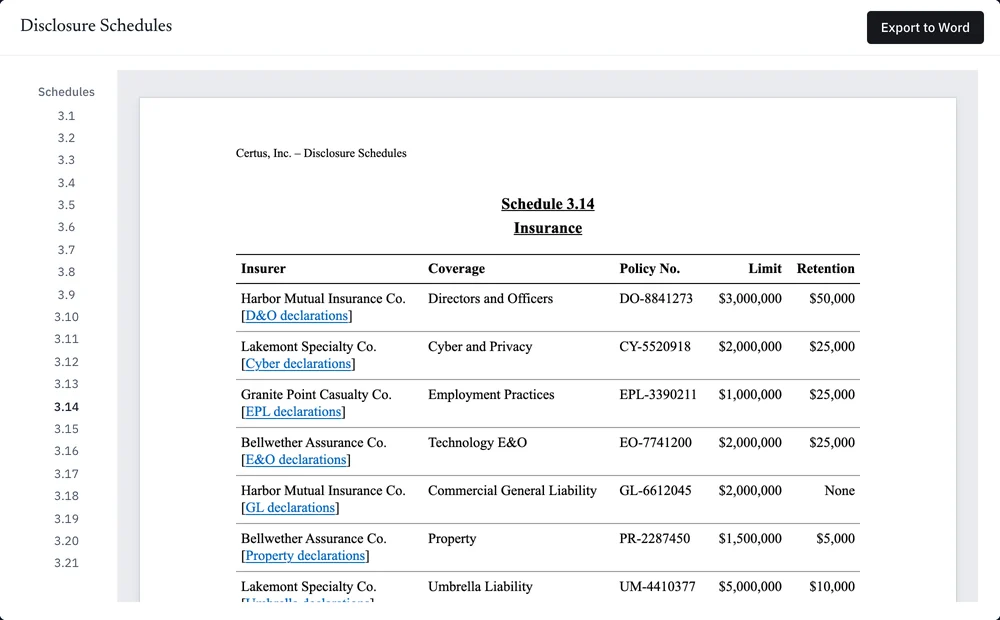
If you’re raising your first priced venture round or selling your company, your lawyer has probably mentioned the disclosure schedule. They may also have told you it will take real work on your part.
In the deal agreement, your company makes a long list of statements of fact about itself. These are called representations and warranties, or “reps.” The disclosure schedule lists every exception to those statements and every detail that limits them. It also contains the lists that many reps require, such as your material contracts, your registered IP and your cap table.
If the schedule leaves something out, the rep it relates to is inaccurate. If the buyer or investors find out later, that can lead to claims after closing, depending on the deal.
What a disclosure schedule does
The reps are legally binding statements in the deal agreement. In a sale, that agreement is often a merger agreement or a stock purchase agreement. In a venture financing, it’s usually a stock purchase agreement, under which investors buy preferred stock from the company. A typical set of reps says things like:
- The company owns its intellectual property.
- There is no pending or threatened litigation against the company.
- The company is in compliance with applicable laws.
- The financial statements fairly present the company’s financial condition.
A full M&A agreement has dozens of reps, and many of them have sub-parts. A venture financing has many of the same reps in shorter form.
The disclosure schedule does two things:
- It lists the exceptions to the reps. If a rep says “except as set forth in the disclosure schedule, there is no litigation pending or threatened against the company,” the schedule lists every lawsuit, demand letter and threatened claim. If a rep says “all material contracts are in full force and effect and no party is in breach,” the schedule lists every contract where any party is in breach, even if no one has complained.
- It contains the lists that many reps require. Many reps require the company to list everything in a category, such as all of its material contracts or all of its registered IP. The rep about the company’s equity may require a list of every outstanding share, option, warrant, SAFE and convertible note. These lists go on the schedule.
Why a disclosure schedule can take weeks
Whether something goes on the schedule, and where, often depends on small details in the rep or in the document.
Defined terms often decide which contracts are listed
Many reps use defined terms, which are capitalized words the deal agreement defines for itself. A rep might require the company to list every “Material Contract,” and the deal agreement might count a contract as material if it meets any one of these tests:
- any contract worth more than $250,000 a year;
- any contract with a customer that accounts for more than 5% of revenue, or a vendor that accounts for more than 5% of spend;
- any contract that grants exclusivity;
- any contract that grants most-favored-nation (MFN) pricing, which promises the customer prices at least as good as any other customer gets.
A customer contract worth $90,000 a year doesn’t meet the dollar test. But it still has to be listed if that customer is 6% of your revenue, or if section 9 of the contract has an MFN clause.
The data room is the shared folder of company documents that both sides’ lawyers work from. Your lawyer checks every contract in it against every test in every definition like this one.
Some contracts give the other party a say in a sale
The deal agreement usually includes a rep that the sale won’t conflict with the company’s contracts. But some contracts give the other party rights when the company is sold, such as a right to end the contract or a requirement that the company get the other party’s consent. If the sale triggers one of these rights, the contract usually has to be listed on the schedule as an exception to that rep. Whether the sale triggers the right comes down to the clause’s exact wording.
Two kinds of clauses come up most:
- A change-of-control clause gives the other party rights when someone new takes control of the company. If the clause covers every change of control, not just certain kinds, a merger or a stock sale almost certainly triggers it.
- An anti-assignment clause requires the other party’s consent before the company transfers the contract to someone else. In most mergers, your company becomes a subsidiary of the buyer and keeps its own contracts. The company generally isn’t treated as transferring anything, so the clause may not apply at all. It can apply if the clause expressly says that a merger or a change of ownership counts as a transfer. In some states, it can also apply if it covers transfers “by operation of law,” meaning transfers that happen automatically in some kinds of merger, without anyone signing the contract over.
What the clause lets the other party do also matters. If it requires their consent, the buyer will usually insist that you get the most important consents before closing. If it lets them end the contract, the buyer has to assess the risk that they will.
Amendments and side letters usually go with their agreement
A side letter is a separate letter that changes or adds to an agreement’s terms. Say you have a master services agreement with three amendments and a side letter on pricing. The schedule usually lists all five documents together in one entry, so the buyer or investors see the whole relationship. If the entry leaves out the side letter, the rep is inaccurate, even though the master agreement is listed.
One contract may need to be disclosed on several schedules
The disclosure schedule is split into numbered parts, one for each rep, and each part is often called a schedule too. For example, Schedule 3.10 goes with the rep in Section 3.10 of a merger agreement. Many venture financings use the National Venture Capital Association’s model documents, which put the company’s reps in Section 2, so the parts are numbered 2.1, 2.2 and so on.
Say your company has a software license with a vendor we’ll call Acme Data. In a sale, depending on its terms, that one license might belong on:
- the Material Contracts schedule, if it’s above the deal agreement’s dollar threshold;
- the No Conflicts schedule, if the sale triggers the license’s change-of-control clause. This is the part of the schedule for the rep that the sale won’t conflict with the company’s contracts;
- the Intellectual Property schedule, because the company licenses IP from Acme Data. Some IP reps leave out off-the-shelf software, so this can depend on what kind of software it is;
- the Required Consents schedule, if the sale needs Acme Data’s consent and the deal agreement has a separate schedule for consents;
- the Top Customers and Suppliers schedule, if what you pay Acme Data puts it among your largest suppliers.
That’s up to five entries for one contract. Depending on what the deal agreement allows, the entry is either repeated on each schedule or listed once and referred to from the others. Now do that for every customer contract, employee agreement, IP license, option grant and investor agreement, and update the entries whenever an amendment or side letter changes a contract. That’s how a schedule that sounds simple can take weeks.
In a venture financing, a new round rarely triggers change-of-control clauses. Most of the work usually goes into the cap table, and into confirming that every founder, employee and contractor has assigned their IP to the company. Expect to list every SAFE, convertible note and side letter from earlier rounds. Also expect to list any rights earlier investors have to buy into new rounds, often called pro rata or preemptive rights. The company has to either honor those rights in this round or get the investors to waive them.
The schedule keeps changing until closing
The schedule comes together over several drafts, mostly while the rest of the deal is still being negotiated:
- Your lawyer typically starts with a first draft built from the documents in the data room. The data room should include your major contracts, your cap table and related agreements, employment documents and other corporate documents.
- Your lawyer asks you about items that aren’t in any document, such as an oral promise or a threatened claim.
- The reps themselves change. The parties may change a dollar threshold, how many years back a rep covers, or how a rep is limited to what the company knows. Each time one of these changes, the schedule has to change too.
- The other side’s lawyers review it. They ask for more detail, and sometimes argue that an entry doesn’t answer the rep it’s listed under or doesn’t belong on the schedule at all. They object to anything vague or broader than it needs to be, because every entry narrows what the reps promise.
The facts behind the schedule can also change after the deal is signed. In M&A, closing often comes days, weeks or sometimes months after signing, while the parties wait for approvals or consents. Some deals sign and close the same day. In venture financings, signing and closing usually happen together.
Between signing and closing, a new lawsuit may be filed, a customer may end its contract, an employee may quit or a contract may be renegotiated. Whether the company can update the schedule for these changes is heavily negotiated:
- Some deal agreements let the company update the schedule between signing and closing. These updates are called supplements.
- Others don’t, so a change can make a rep inaccurate at closing.
- Even when supplements are allowed, the buyer may still be able to bring a claim after closing for a change the company reported in one.
When there’s a gap, the buyer usually has to close only if the reps are still true at closing. Often they only need to be true “in all material respects,” but the parties can negotiate a different standard. This condition is called the “bring-down,” and at closing an officer usually certifies that it’s met.
Some venture rounds have later closings, to add investors or to fund a later installment of the investment. The bring-down is usually repeated at each one.
Three mistakes first-timers often make
Items that feel minor still have to be listed
Some items feel too minor to list. Think of the change-of-control clause in a vendor contract you barely use, a side letter that gives one customer MFN pricing, or an oral promise of a retention bonus to a key employee.
If you list too much, the other side asks more questions. If you list too little, the buyer or investors may find the gap months later, when it’s harder and more expensive to fix.
The data room usually doesn’t count as disclosure
People sometimes assume that a document in the data room doesn’t need to be on the schedule, because the other side’s lawyers can find it there.
But the reps make exceptions only for what is “set forth in the disclosure schedule.” Even if the other side has read the data room and knows about a contract or fact, the schedule still has to disclose it.
Some deals do treat the data room as part of the disclosure, but that’s rarer in the US. Unless your lawyer says your deal works that way, put the item on the schedule.
“Knowledge” usually includes what you should find out
Your lawyer will usually try to limit certain reps to the company’s “knowledge,” so that the rep covers only what the company knows. First-time signers sometimes hear that and assume they don’t really need to check anything.
But in most deal agreements, “knowledge” also covers what you should know after asking the people who would know. If you never asked your head of engineering whether anyone has threatened a patent claim, that limit may not protect you the way you assumed. Read how your deal agreement defines “knowledge” before you rely on it.
Mistakes can lead to claims after closing
What a mistake can cost depends on the kind of deal.
In a sale:
- Survival period. After closing, the buyer usually has a negotiated window to bring a claim for an inaccurate rep. This is called the “survival period.” Depending on the deal, it can run a year or so for most reps. For the most important reps, called “fundamental reps,” it can last many years or indefinitely. Sometimes it lasts until the statute of limitations runs out, which is the legal deadline for bringing a lawsuit. Fundamental reps often include the company’s authority to sign the deal, who owns its shares, and taxes.
- Escrow. Many M&A deals hold back part of the purchase price in an escrow account with a third party. If a rep is inaccurate, the buyer can make a claim against that account. That money would otherwise go to the selling stockholders, so they bear the cost, not the company.
- Caps. The total the buyer can recover is usually capped, often at a percentage of the purchase price. For fundamental reps, the cap often goes up to the full purchase price.
- Fraud. These limits usually don’t apply to fraud, and knowingly leaving something off the schedule can be fraud. In that case the sellers, especially any who knew, can face claims beyond the escrow, the cap and the survival period.
- Insurance. Many buyers now also take out representations and warranties insurance. It moves most of the risk of an inaccurate rep to an insurer, and it shrinks the escrow, sometimes to nothing. But the policy usually doesn’t cover problems the buyer knew about before signing. It also doesn’t cover losses below its deductible, called the “retention,” and sellers often pay part of that. Sellers also often remain liable for fraud, and in some deals for fundamental reps above the policy limit.
In a venture financing, founders usually don’t make the reps personally. There’s usually no escrow and no indemnity, meaning no contract right to be repaid for losses from an inaccurate rep. Investors also rarely sue a company they now own part of.
Still, the reps usually have no contractual end date, so investors can bring a claim until the statute of limitations runs out. At closing, the CEO usually signs a certificate on behalf of the company confirming the reps. A knowing misstatement can lead to fraud or securities-law claims, including claims against the people who made it. An inaccurate rep also tends to come up again at the next financing or at a sale, when it’s harder to fix.
How to help your lawyer get it right
- Put every contract your lawyer asks for in the data room, with all of its amendments and side letters.
- Make sure your cap table matches your board approvals and signed documents. Tell your lawyer about any equity you promised, even informally, but never granted.
- Confirm that every current and former founder, employee and contractor signed an IP assignment, and that the founders assigned what they built before the company was formed. Tell your lawyer about any gaps, and about any former employer or university that might claim the work.
- Tell your lawyer about anything that isn’t written down, like an oral promise to an employee or a threatened claim.
- Before answering a question about what the company knows, ask the people who would know.
- Answer your lawyer’s questions fully, even when an item feels minor.
Marveri drafts the first version, fully cited
Marveri’s AI agents draft disclosure schedules for law firms that handle venture financings and M&A deals. Your lawyers upload your data room and the draft deal agreement. Marveri then produces a draft schedule with a citation to the source document under every entry.
Marveri also runs public-records searches on the company and its officers, covering liens, litigation, bankruptcy, business registrations and IP. It adds the results to the draft schedule for your lawyer to review. That way, a filed lien or lawsuit that never made it into the data room can still be caught.
Marveri’s draft is a starting point. It doesn’t replace your lawyer’s judgment, and the company still has to do its part in reviewing and finalizing the schedule.
Marveri can cut the time spent assembling the schedule. Your lawyer can then spend more of their hours on judgment calls: what to disclose, how to word each disclosure and how to respond to the other side’s objections.
To see how this works on a sample deal, book a demo.
Common questions about disclosure schedules
What happens if my schedule is wrong after closing?
In a sale, the buyer can bring an indemnification claim, a claim to be repaid for its losses from the inaccurate rep. It has to do so within the survival period. In sales of venture-backed companies, that’s commonly twelve to eighteen months for most reps. Fundamental reps like capitalization and authority usually survive longer, sometimes until the statute of limitations runs out, or indefinitely. If there’s an escrow, payment typically comes out of it, and the total is capped at a negotiated amount, often a percentage of the purchase price. In deals with representations and warranties insurance, most of the payment comes from the insurer.
In a venture financing, there’s usually no indemnity and no escrow, and the reps usually have no set end date other than the statute of limitations. Investors rarely sue, but an inaccurate rep can still create real liability. A knowing misstatement can lead to fraud or securities-law claims. An inaccurate rep also tends to come up again at the next financing or at a sale.
What’s a knowledge qualifier?
A knowledge qualifier is wording in a rep that limits the rep to what the company knows, instead of guaranteeing the fact is true. The deal agreement says whose knowledge counts, usually a named list of officers. It also says whether “knowledge” includes what those people would learn by asking reasonable questions. Read that definition, because “knowledge” usually means more than what’s in your head right now. It typically includes what you should know after asking the right people.
Can I just disclose everything to be safe?
Listing more is usually safer than listing less, but every entry has to be specific. A single line saying “all customer contracts” isn’t a real disclosure. The schedule is supposed to give the other side enough detail to assess what they’re taking on. Vague entries fail that standard, and a court reviewing them later may not count them as disclosure.
How is a disclosure schedule different from a data room?
The data room is where the other side’s lawyers find the documents they use to verify your reps. The disclosure schedule is the company’s own written list of the exceptions to those reps and the details that limit them. It also contains the lists the reps require, like material contracts and the cap table.
The schedule points to specific documents and information, and most of them should also be in the data room. By itself, putting something in the data room usually isn’t the same as disclosing it on the schedule.
About the author
Connor Acle is the co-founder and CEO of Marveri and a former M&A lawyer at Morrison & Foerster. This primer is general information, not legal advice.
